


We’re bullish on onchain capital formation. We also have to be honest that nearly every attempt at it has failed, or at least fallen short of what it promised.
The ICO wave marked the first real attempt, where users could buy tokens of projects on the promise of an increase in token value as the token succeeds.The key word here is ‘promise’, as in reality, in most cases nothing linked the token with the project itself: without any real say on the IP, treasury or even the direction of the protocol, the stats speak for themselves: 85% of 2025’s token launches with real teams and real products trade below their launch price. The median is down 71%.
Tokens were meant to represent the project, but instead usually they are a second product with very little to do with actually governing or decentralizing decision making. Often, there is even a dual token-equity model, making it unclear what tokenholders actually control. Ideally, a token should be a pivotal part of the project, and necessary for the success of the project.
MetaDAO recently built the first serious attempt at linking the venture to the token. Futarchy-governed treasuries. Monthly team budgets. Structural spends gated by decision markets. Project IP assigned to an entity bound by that governance.
Proven effective and working on Solana: fourteen projects, roughly $45 million raised, and a community convinced this is how token launches should work. The decision markets governed real treasuries. The ownership mechanism is proven. However, the launch design and market structure did leave plenty of room to build past the original concept.
Our portfolio company Umia is set on fixing these issues, bringing the next generation of token-native companies to the EVM. Here’s what their stack combines that nothing else has.
Organic Price Discovery beyond a blinking contest. Umia’s Tailored Auctions run on Uniswap’s Continuous Clearing Auction (CCA) mechanism, and are meant to address the issues we see from traditional Bonding Curve or Dutch Auction models. Rather than introducing the high price volatility of a whole token’s supply selling in a few blocks, CCAs distribute the token across different ‘buckets’, and people’s bids are divided from the earliest bucket they are eligible for to the later ones. By implementing this mechanism, Umia opts for a more organic price discovery and the possibility for people to participate all across the auction,
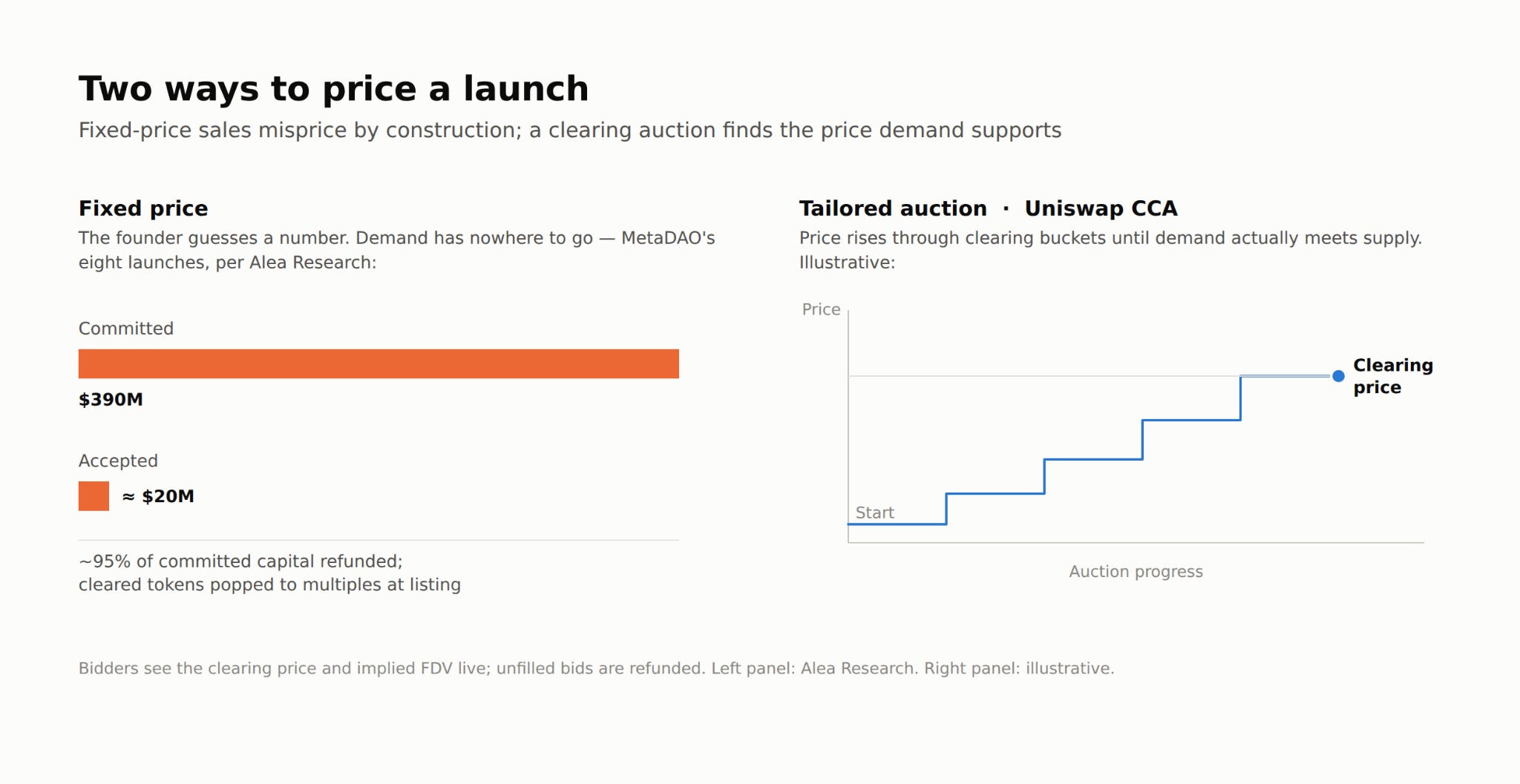
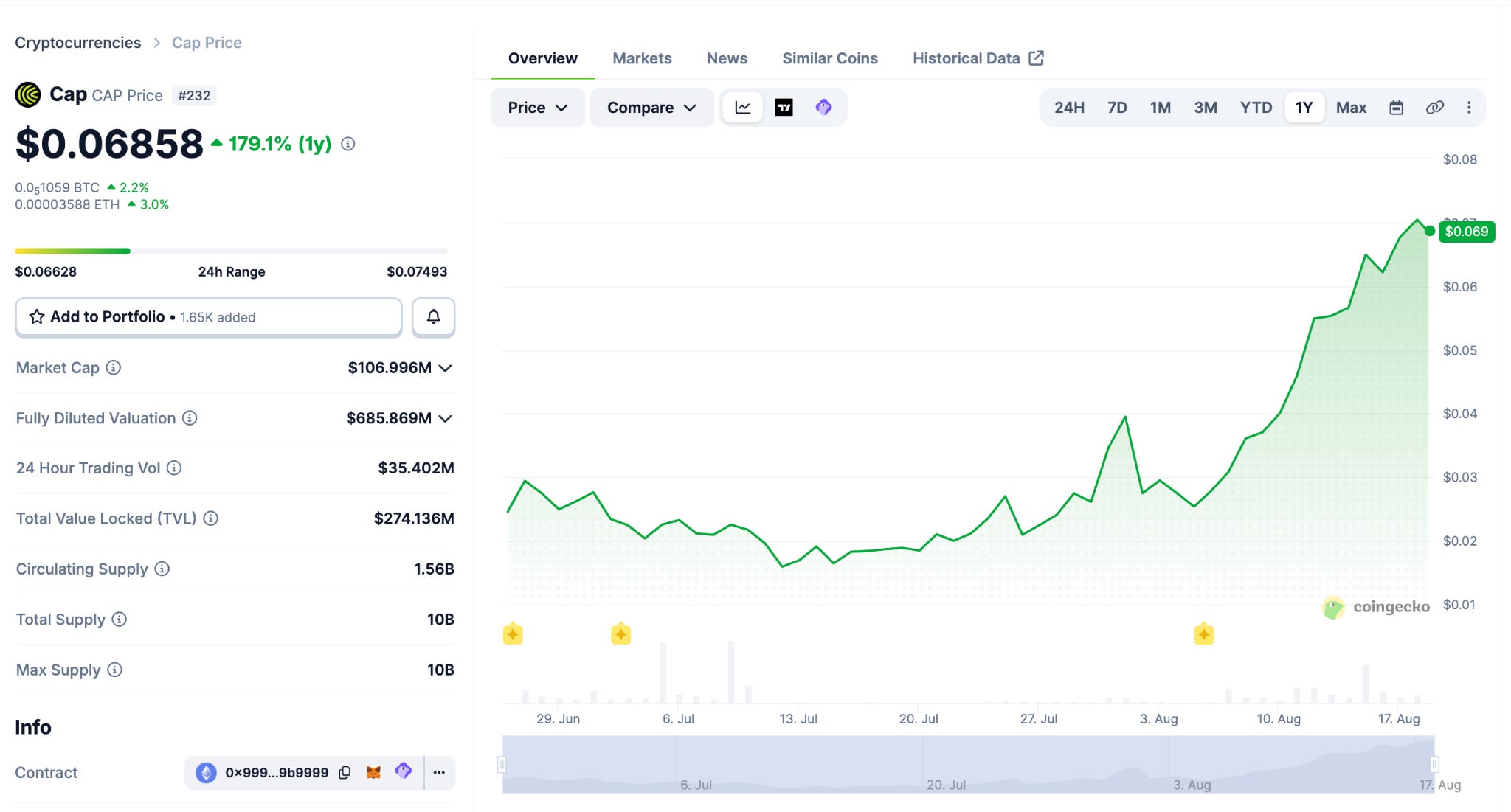
This mechanism already has a proof point: Cap Labs ran its auction on CCA in June with over a thousand bids, 5.5x oversubscribed, cleared at a $106 million FDV against a $75 million floor. Since, CAP has never traded below its clearing price.
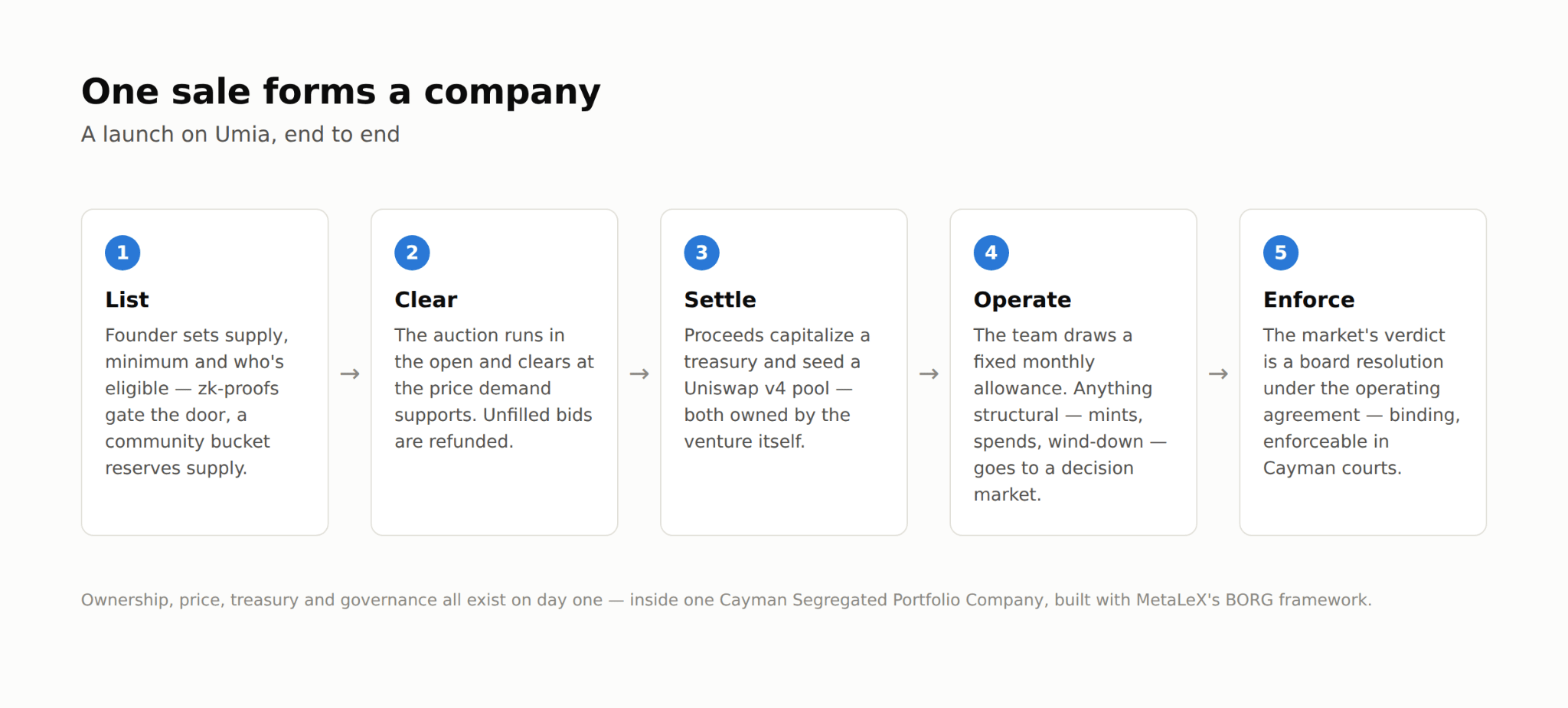
Include your community, privately . Umia layers zero-knowledge gating onto the auction. Using the Umia browser extension, any user can prove their eligibility for onchain or offchain criteria, without the information ever leaving their device. This allows founders to build a community with stronger conviction, and unlocks for these users a specific community bucket reserved for them. From AI token usage to prediction market trading activity, founders can now cater for the community they want, without disclosing who each bidder is.
Multiplex markets with real accountability. Earlier token polling attempts kept decision making as a symbolic suggestion at best. MetaDAO iterated on this concept significantly, but with just a Yes/No market, there are only so many options that can be framed under this format.
On Umia, every major strategic decision (minting more tokens, spending from the treasury, winding down) has to clear a decision market first, with conditional prices for each outcome trading against each other in the open until one wins. This, however, extends beyond binary voting. Thanks to their conditional trading infrastructure, users can express their opinion of each conditional vote among unlimited options, with liquidity scaling along with it. Thanks to this, market signals can be expressed much clearer, with traders expressing their positions among finely grained markets. Once an outcome is chosen, Umia’s legal wrapper, built on a Cayman Segregated Portfolio Company, is treated akin to a board-level decision, and the team is accountable to executing the votes’ direction. The team is legally required to act on it. If they don’t, they’re in breach, and the breach is enforceable in Cayman courts.
One legal wrapper, built for founder flexibility. Umia has a standardized legal framework: one Cayman Segregated Portfolio Company, each venture a segregated portfolio inside it whose liabilities don’t touch the others’ by statute rather than by covenant.
On top of all the previously mentioned improvements, there is one more thing Umia is tackling: adverse selection. Are the best founders raising onchain? Great founders can typically raise a clean venture round tomorrow. If onchain sales only attract the founders who couldn’t, adverse selection kills the model no matter how good the machine is.
But Umia’s bet is that with the right infrastructure and flexibility in place, the benefits of community ownership become extremely attractive. Umia allows projects from any setup to migrate to their format, and if necessary, they permit for spinning out and dissolution (assuming that decision markets are in favor)
Community ownership will win in the long run. If you earned a sliver of Uber stock every time you took a ride, you’d feel something no loyalty program produces: actual ownership. You’d ride more. You’d talk about it. You’d care how the company is run, because you share in the profits and the decisions. Customers who are owners are a moat, and tokens are the first instrument that can distribute that ownership at internet scale.
Thanks to the non-custodial treasury setup, users who normally would not participate in such an auction might also participate in this one, as they know their tokens are not just in a team’s multisig.
The full stack is live on testnet today, and mainnet and the first auction ($UMIA itself!) close behind. Ethereum needs ventures worth owning and a machine that forms them. And that machine is Umia.
Bankless Ventures (BVC), an early-stage venture fund backed by dozens of leading founders and GPs.
We’re currently fundraising for Fund II. If you want to invest in BVC Fund II, you can submit an interest form as a Limited Partner (LP):